
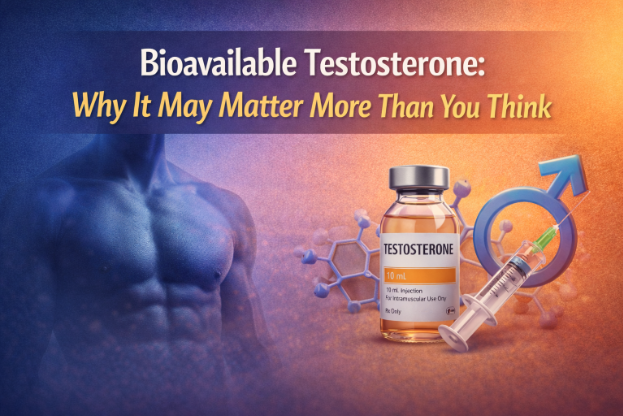
Why It May Matter More Than You Think
You are doing all the right things, but your body will not respond
You eat clean.
You move your body.
You try to sleep better.
You cut back on sugar.
Still, you feel tired all the time.
Your weight will not budge.
Your motivation is gone.
You do not feel like yourself anymore.
Your labs come back and you are told they are normal.
Patients say this every day.
“I feel crazy because the numbers look fine.”
“I’m trying harder than ever and getting worse results.”
“I just want my body to work again.”
This is where bioavailable testosterone gets overlooked.
What Is Bioavailable Testosterone in Simple Terms?
Testosterone exists in different forms in your body.
Some of it is tightly bound and locked away.
Some of it is free and usable.
Bioavailable testosterone is the portion your body can actually use.
This is the testosterone that affects:
- Energy
- Mood
- Muscle
- Fat loss
- Mental clarity
You can have normal total testosterone and still feel terrible if your bioavailable testosterone is low.
Why Bioavailable Testosterone Affects Weight Loss
This is one of the most common frustrations we hear.
“I eat less than I used to and still gain weight.”
“I work out but I feel weaker.”
“My body feels inflamed and slow.”
When bioavailable testosterone is low:
- Your metabolism slows
- Muscle breaks down more easily
- Fat is stored more easily
- Recovery feels harder
Weight loss becomes an uphill battle no matter how disciplined you are.
Why Conventional Medicine Rarely Explains This
In conventional care, the focus is usually on one number.
If total testosterone falls inside a wide lab range, you are told it is fine.
No one explains:
- How much testosterone your body can actually use
- How stress and binding proteins affect hormones
- Why symptoms matter more than a reference range
You leave feeling unheard and frustrated.
How Functional Medicine Looks at Testosterone Differently
Functional medicine looks at the full picture.
We use advanced testing to evaluate:
- Total testosterone
- Free testosterone
- Bioavailable testosterone
- SHBG and cortisol
- Inflammation markers
We connect these results to how you feel, how you move, and how your body responds to effort.
That is how patterns start to make sense.
Is Tirzepatide a Peptide and Why People Ask About It
Yes. Tirzepatide is a peptide.
Peptides are small messengers that tell your body how to behave.
Semaglutide and tirzepatide help regulate appetite and blood sugar.
Many people look into these because they feel stuck and exhausted.
Patients tell us:
“I don’t want a quick fix.”
“I’m scared of gaining the weight back.”
“I want something sustainable.”
Peptides can help some people short term.
They do not fix low bioavailable testosterone.
Supporting Hormones Without Forcing Weight Loss
In functional medicine, we focus on support before force.
We look at sleep, stress, nutrition, and recovery.
Some patients benefit from foundational tools like hydrolyzed bovine collagen peptides to support joints, gut health, and tissue repair so their body can respond better to movement and healing.
When the body feels supported, fat loss becomes possible again.
Why How You Feel Still Matters
If you feel exhausted every day, that matters.
If weight keeps creeping up, that matters.
If you do not recognize yourself anymore, that matters.
You are not failing.
Your labs just may not be telling the whole story.
Want to Learn More Before Making Any Decisions?
If you are tired of surface level answers and want to understand why weight loss feels so hard, education is the best place to start.
Our podcasts and webinars break down hormones, metabolism, and why “normal” labs often miss the real issue.
No pressure.
No sales pitch.
Just real explanations that help you finally feel understood.
When you understand the root cause, the path forward becomes much clearer.


doxycycline hyclate 100 mg cap
doxycycline hyclate 100 mg cap
mebeverine hydrochloride
mebeverine hydrochloride
atorvastatin calcium 80 mg
atorvastatin calcium 80 mg
finasteride proscar
finasteride proscar
diflucan for yeast
diflucan for yeast
tetracycline 500mg
tetracycline 500mg
dutasteride for hair loss where to buy
dutasteride for hair loss where to buy
Comments are closed.